Kingian Nonviolence – Avoid internal violence of the spirit, as well as external violence

This principle focuses on the internal violence that can play out in conflicts, either towards others or ourselves – blame, judgement, hatred, guilt, depression, burnout and ill will, a kind of violence to our own spirit or sense of wellbeing. In a way this principle is a commitment to accompanying ourselves and reconnecting to care, including to seek support if we need it.

We explored options available to use to make sense of the world when someone says or does something that harms us:

  • Blame the other person, e.g. labelling them stupid, evil or something else.
  • Blame ourselves, e.g. believing it must have been something we did wrong or misjudged.
  • Recognising both our needs and theirs and feeling the emotional impact of that, responding empathically.

In my own upbringing, the focus was very much on intention and what was right and wrong, and therefore blame. It is a constant relearning to wonder and inquire what is underneath, what is the impact and what were the needs trying to be met by an action.

Within this we spent some time exploring Rage, and how it connects to Love – how it can show us what we most deeply love and want to protect…

  • Rage arises when we lose care and when seeking is blocked (for example if it doesn’t seem safe to ask for what we want)
  • When rage is blocked and we can’t go to seeking what we love, we often experience collapse, (for example depression)
  • We also experience rage when coming out of a ‘freeze’ immobilisation response (often through trauma)
  • Rage can connect us to what we most deeply love and want to protect (for example our freedom or autonomy)

Poet David Whyte suggests “Anger is the deepest form of compassion” – we can use this to find out ‘what is being loved with this force’?. When we feel ‘Angry At…’ (at someone we want to be different), we can honour that as love and transform it to ‘Angry That…’ (connecting to what we love).

To me this principle reminds me to connect to the needs underneath what is going on, to self empathy and empathy for others, to seeking support when I feel stuck in the story and judgement, and to see this internal violence as part of continuing the cycle.

Next up: Principle 6 – The universe is on the side of Justice

Liberating structures

I’ve loved stumbling across ‘liberating structures’ – a fantastic menu of tools and practices for many-to-many communication.

“Liberating Structures are easy-to-learn microstructures that enhance relational coordination and trust. They quickly foster lively participation in groups of any size, making it possible to truly include and unleash everyone.”

Beyond conventional structures of presentations, managed discussions, open discussions, status reports and brainstorm sessions, there is a menu of structures freely available to use (ordered simplest to learn first at the top left), and there is also a ‘matching matrix‘ to help match structures to goals.

One simple example I enjoyed recently was using a set of starter questions to build trust and engagement – so simple and so effective…

  • What first inspired me in my work is…
  • Something we must learn to live with is…
  • A bold idea I recommend is…
  • What I find challenging in our current situation is…
  • Something we should stop doing is…
  • A courageous conversation we are not having is…
  • A question that is emerging for me is…

Another brilliant tool for exposing and strategising when there appears to be conflicting needs is to find the ‘Wicked Questions‘ using the starter “How is it that we are … and we are … simultaneously?” – moving the question to an ‘and’ that includes both. ‘Integrated Autonomy‘ is a more in depth way to help a group move from either-or conflicts to both-and strategies and solutions.

(NB: Convergent Facilitation is the most effective way i know currently to find a way forward when there are a lot of different perspectives and needs to take into consideration.)

I also love the ‘Conversation Cafe‘ (and similar formats) to build trust, reduce fear and make sense of complex, difficult or painful situations.

There is so much here to explore! If you are interested to try out using Liberating Structures with your group or community, browse liberatingstructures.com or get in touch if you would like support.

Kingian Nonviolence – Accept Suffering without retaliation, for the Sake of the Cause to Achieve the Goal

This is one of the most challenging principles for many, and asks deep questions of us – who is suffering, what are we choosing to take in and close off from, where are people suffering involuntarily, and where might we be willing to voluntarily accept suffering in order to be an ally and support others?

Through the 50 days for peace course, we explored several questions…

  • Who is bearing the bulk of the suffering for unjust systems in our communities?
  • How can we support systemic injustice being seen and attended to?
  • What do you love more than retaliation?
  • Where might you be willing to accept suffering voluntarily in order to reduce harm?

With so much in our culture based on judgement and blame, it can be easy to fall into guilt and feeling ‘not enough’. This principle asks us to re-centre those who are being impacted, be really conscious about what we let in and keep out, and without giving up care for our own capacity and limits. We also explored the resources, training and community support it takes to accept suffering in some of the ways people have been called to, and also all of the ways we can support people who are willing to make sacrifices.

Can we find the courage and capacity to take in the involuntary suffering of others, within our limits? How can we resource ourselves to do this? And centring their experience, is there some action we can take that might reduce harm?

If you are open to it, you could listen to this recording from a US customs and border protection facility, sensing into the suffering of all those voices in the recordings, and in yourself.

Next up: Avoid internal violence of the spirit, as well as external violence >

Where we are and Vision

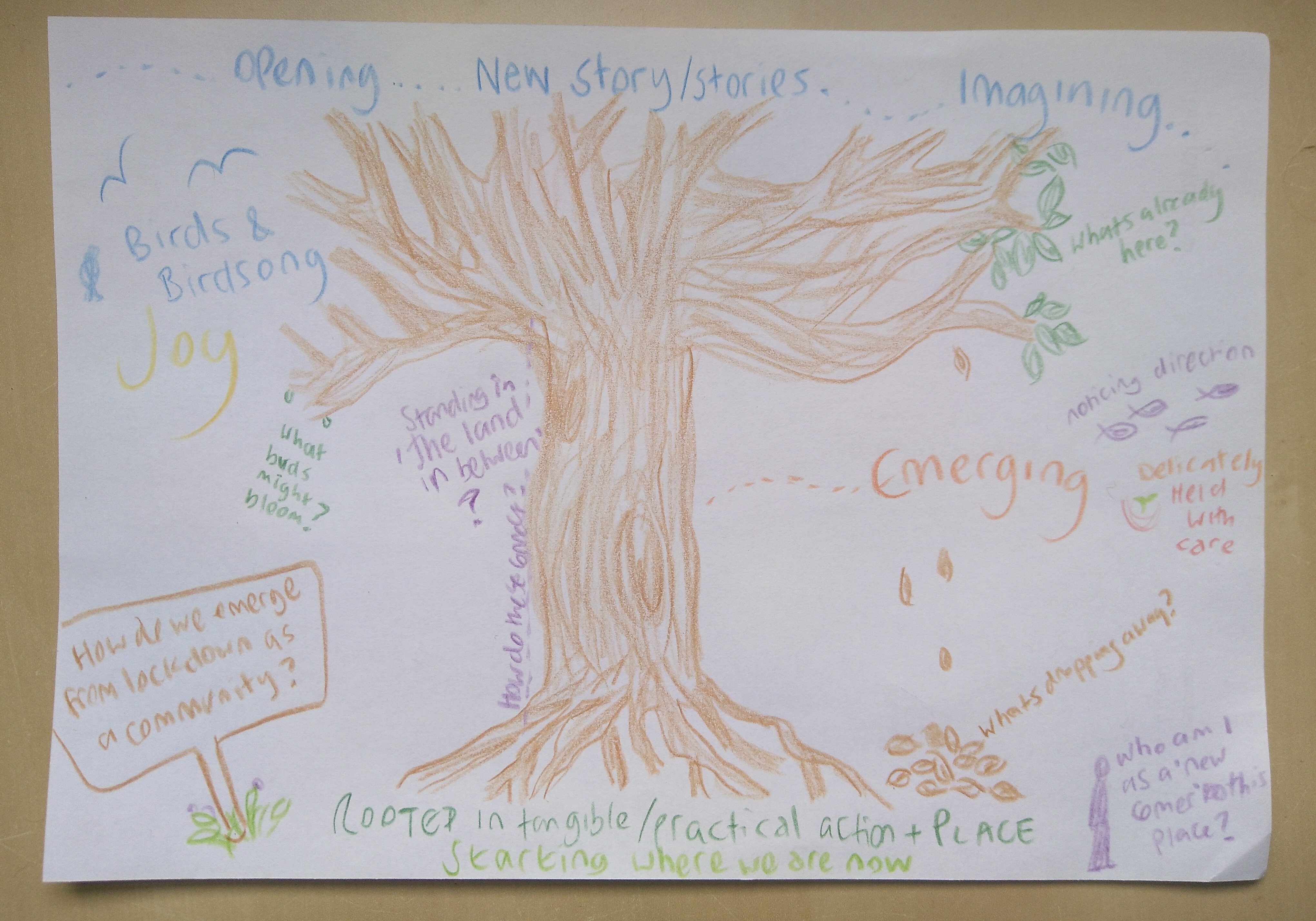
I have a recurring question lately… how can we both start where we are, rooted in current experience AND create conditions for imagining a new paradigm, open to a radically different vision?

I spend time in spaces that focus on current situations, and spaces that are imagining the new, and I often wonder where and how the two might meet, might influence each other. How do we imagine and create a new world beyond current structures and limitations, without disconnecting from the ground, seeming out of touch with people’s everyday reality?

A friend shared a practice with me from a Scottish innovation space that has something to offer this called ‘Standing in the land in between’* – spending time seeing where we really are, spending time imagining something new, and then standing in between and seeing what emerges. (*I think this is the right name – I’ve not yet managed to find a link.)

This leads me to reflect on how this happens inside of me – the past, present and imagination of future possibilities is all here now, in the present. Sometimes imagining a different future can be an inspiration and guide to new possibilities, and sometimes it is a way I avoid seeing reality, feeling the pain and mourning what’s not working.

I can imagine this mirrored in social change work too. How can we open to reimagine a world where all needs matter, where all life can thrive, without avoiding what’s here now, the suffering and the grief and the joy and the care?

I see what ULab/TheoryU can bring to this – seeing the present in ever expanding awareness, from other perspectives, inspired by what others are doing… and then pausing in all of that, feeling and sensing what is here, and listening for the new emerging. We are experimenting with this through GM Transformation Lab, and I’m longing to be in more diverse groups to explore.

Where do you see great work being done in the ‘what’s here now’ and deep imagining of ‘what could be’, and where and how do you see them coming together?

I sense new possibilities emerging from the space between, and would love to hear the questions stirring in you.

Roots and vision

Kingian Nonviolence – Attack forces of evil not people doing evil

This weeks principle may take some unpacking for many of us, maybe especially for those committed to nonviolence who might have rejected ideas of evil and hear ‘attack’ as violent. I’m grateful for the encouragement to start where I am and explore my current felt sense and ideas around these words…

For me ‘evil’ is tied up with the idea of ‘bad intention’. As I grew up the focus was on naming (and sometimes shaming) the intention behind an action, and on admitting my actions were ‘bad’, rather than focus on hearing the impact. For some of us the word ‘evil’ brings up concepts of fixed right and wrong, of bad actions and bad people, and associations with religion and authority.

Similarly while in ‘attack’ there could be ideas of violence, there is also a strength and conviction, with the object of this being the forces (structures, beliefs, systems, habits), and not people. This is an active and proactive strength, finding the energy and courage to do the work that needs to be done to reduce harm.

Something like “dismantle and upgrade systems and institutions doing harm, rather than blaming individuals” lands more easily in me in this moment. AND there still seems something valuable about inquiring into my relationship to these words, maybe reclaiming them with a new understanding. As I think about systems and beliefs that lead to harm, systems that really don’t meet the needs of many, and that actively oppress, might that be a new understanding of ‘forces of evil’?

I loved Roxy and Cathy’s unpacking of this idea during 50 days for peace, at the same time as encouraging people to find the words that resonate for them, and allow others to choose differently. And so from there, in words that speak to you, how you might complete this sentence?

I want to find the strength to attack forces that [do what] by [how].

Some things coming up for me…

  • “I want to find the strength to dismantle systems and structures that threaten our shared conditions for life, by reimagining ways forward where all can thrive.”
  • I want to find the strength to challenge and dissolve ideas of fixed right and wrong, by supporting groups to connect to their needs and find more creative solutions.”

As we each focus our attention on what matters most to us, bringing the skills and strengths we have, something new and more attuned to needs seems more likely to emerge.

Community and accompaniment

All of this is a lot to ask, especially for those recovering from trauma or still facing oppression and violence. Another key concept from this week is to understand the need for support and resourcing ourselves for the fight . We need to find accompaniment – develop our own capacity to accompany ourselves, and to seek support. We need to find community – to lean on each other and know that we will all have different capacity to show up in different ways at different times. We need to find what resources us – coming from gratitude, time in nature, time to rest, music, friendships, pets, touch, whatever helps us reconnect and recover.

Personal and systemic

I’m so grateful too for reminders to notice both systemic and personal layers in this. There can be a tendency for some of us to focus on the personal (especially with an NVC lens), and miss the systemic. If a person is talking about pain related to the systemic, there might also be personal pain, but to go only to the personal can be painful, and also not feel safe if there is not consent.

I remember several times in working in homelessness partnerships people who had experienced homelessness talking about the injustice around housing and support, and anger around how people are treated for not being in work, and sometimes the focus has gone to their personal circumstances. I’m grateful for this clarity, to discern the personal and systemic, and be aware of the level someone is speaking at – an edge which I am still learning to work with.

Systemic change

In this intersection between the personal and systemic there is opportunity. Systems are created and maintained by repeated behaviours (including compliance and silence), and systems are changed by new behaviours. So what might nonviolent action that changes systems look like in the contexts we are in?

Kathleen brought in research by Erica Chenoweth and Maria J Stephan that points to the success of nonviolent resistance, and some of the attributes needed…

  • A large and diverse population of participants sustained over time
  • Capacity to create loyalty shifts in groups that support current systems/institutions
  • Creative imaginative methods of resistance
  • Organisational discipline to face direct repression without going to violence or collapse

There is much to unpack in all of this, and I’d love to spend more time pondering all of this with others as we head into whatever comes next.

Up next – Principle 4: Accept Suffering without Retaliation for the Sake of the Cause to Achieve the Goal >

Kingian Nonviolence – Beloved Community is the Framework for the Future

Beloved community is a vision of a world where all are included in the circle of care, where all needs matter. So the work in this part is to wonder about the current edges of our care, where it is not easy to see the humanity of others, and to include our own needs, to really check if we are leaving out anything of ourselves. And then to ask if we have the systems, processes, skills and support we need as a community or society…

  • Where are the edges of our care?
  • Where do we hold blame (for others or ourselves), and what might the mourning be underneath?*
  • How do we make sure always that our own needs are included, and check for real willingness?
  • How do we set up restorative systems that support us to reconnect when there is tension?

(* I’d highly recommend checking out more of Sarah Peyton‘s work around blame and mourning – you can find a detailed version of the ‘Transforming Blame into Mourning’ process here.)

An important reminder for me came from Roxy Manning‘s sharing, that there might be situations where we need to say to people in our lives “you are still part of my community but I won’t let you harm us” – Beloved Community has to include us and our families, our own safety. I enjoyed these questions posed: When you consider the invitation to live in beloved community:

  • In what circumstances do you exclude yourself? What needs does this meet?
  • In what circumstances do you exclude others? What needs does this meet?
  • How would it serve you to strive to include yourself or others more in the circumstances you named?

We will have moments of ‘I just cant do it’, where needs for safety, understanding, care, rest and others are at risk, where it feels really challenging, and we need support to find the next step.

“If you are not struggling to love people, if you are not trying to build understanding with those you disagree with, then you are not really doing the work of building Beloved Community. The work of building Beloved Community is understanding that we’re not trying to win over people, but to win people over.”

Kazu Haga from ‘Healing Resistance’

It’s important for me to know that while I so want a world where all needs matter, and wish for everyone to want that too… and to know that’s not the reality, I can’t expect anyone else to, and this is part of the work.

Coming up next – Principle 3: Attack forces of evil, not persons doing evil >

Revolutionary Love – Love Our Opponents

The core wisdom of this section of the Revolutionary Love compass is ‘Tend the Wound‘ – an understanding that underneath tension, conflict and division is so often hurt that has been left untended. We go first to ourselves, to see if we need to rage first, before really checking in with ourselves whether we are ready to listen to understand opponents, and then be ready to reimagine together.

Again it feels such an important reminder that this work is to be done in community, that we will all play different roles at different times, and can honour where we are and not feel we need to do all of this ourselves.

Rage

In many of us, rage is something we might not be comfortable with, or might skip over to get to action or to try and find empathy for the other. The lesson of this part of the compass is tending our own wounds by finding ways to express our rage in a safe container, and allow our bodies natural response to the hurt, with whatever support we need to do that.

Listen

When it really feels safe to do so for us, in our bodies, there is a choice to step towards our opponents with curiosity, to listen to understand their perspective. This is the work of listening for the wound in others – taking in different perspectives, alongside rather than instead of our own, so that we have the possibility of finding solutions that can work for all.

Reimagine

When we tend to our wounds and connect to the wounds in others, we have the possibility of reimagining institutions that could work for all. Some of the institutions might need to change, others to be dismantled and created again from scratch.

In each of these steps i feel hope, that there is a possibility, a map, that doesn’t try to jump over the hurt, and that also gives a way forward to create the new.

Next up: Love Ourselves >

Kingian Nonviolence – Nonviolence is a way of life for courageous people

Kingian Nonviolence has been developed from the legacy of Dr Martin Luther King Jnr, and contains a depth of practice captured in six principles. My connection with it has been greatly supported by Kazu Haga’s excellent book ‘Healing Resistance’, and by the ’50 days for Peace’ course I’ve been part of through the start of this new year. Here’s a little taste of each of the six principles, (I’ll be adding one each week)

Principle 1 : Nonviolence is a way of life for courageous people

Nonviolence is not an easy path. It is beautiful and rewarding, and it can take courage to actively resist harm, to choose to step towards action when others are in harms way. Here are some questions to start that exploration…

  • Where do you see violence in the world? Where do you see people being harmed by actions, words, systems, decisions about where resources are directed to?
  • Where are there opportunities to stand not only in solidarity but as an accomplice to reduce this harm?
  • What scares you about standing up to violence? Where might you need support to find the courage to do this?
  • Where do you need to find care for yourself, stand back, trust others will be there to prevent harm when you need to rest?
  • Where have we made unconscious contracts with ourselves to behave certain ways to meet needs, regardless of the cost to ourselves? (you can find out about unconscious contracts here)

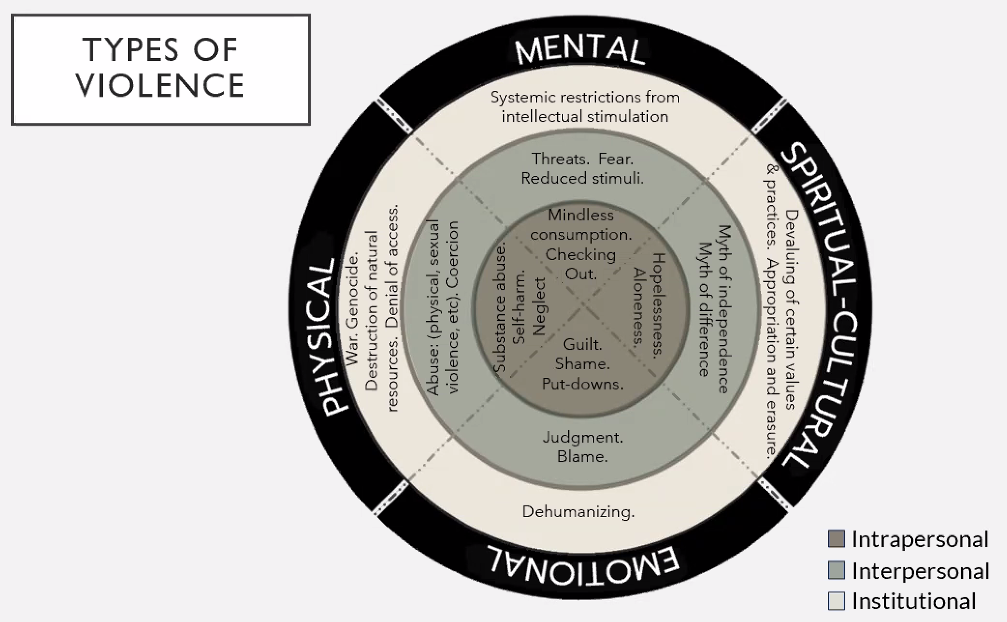
I’m really grateful to Roxy Manning for this extended awareness of different forms that violence takes, and opportunity to review where in my life these show up…

Up next – Principle 2: Beloved community is the framework for the future >

Revolutionary Love – Love Others

Valarie Kaur’s beautiful brilliant Revolutionary Love Project compass offers an orientation and practices to find love for others who are experiencing harm, love for our opponents, and love for ourselves.

Absolutely core to this work is understanding this is something we do as community – to know we all have different roles to play in each moment, and to trust our body as a guide to what is right for us.

Revolutionary Love Project Compass

I’d highly recommend following the content at valariekaur.com, or the brilliant series that is US based but applicable to all at The People’s Inauguration. Here is a taster of what you can find there…

Love others – See no stranger

How do we cultivate our love for others, our willingness to take action to protect what is at risk of harm?

How can we look at any other living being with the mindset ‘you are a part of me I do not yet know’…

Revolutionary love gives 3 practices…

1. Cultivate wonder

Seeing others with wonder, being curious about their story, what breaks their heart, what they want and care for.

“I am defining wonder as letting in a sense of awe and openness, deep curiosity. It is to look upon the face of anyone or anything and say ‘you are a part of me, I do not yet know’. Its an orientation of humility. Wondering about another person, their thoughts and experiences, their pains and joys, their wants and needs, gives us information for how to love them. It’s how we have learned how to love our partners, our children, our friends. Now when we wonder about those who we would otherwise see as strangers, let even them inside of our circle of care, then wonder becomes an act of revolutionary love.”

2. Grieve together

Whose grief have we not let into our hearts? When we come together to grieve, to hear someone else’s story of heartbreak, and let in their pain, we are saying ‘you grieve, and you do not grieve alone’. This is part of how we love others.

3. Fight together

From wonder and grieving together, we can notice and honour the impulse from inside us to fight against injustice, to take action, to prevent harm, to show up in active solidarity, to be there as an accomplice from a place of love.

“To fight is to choose to protect those in harm’s way. To fight with revolutionary love is to fight against injustice alongside those most impacted by harm, in a way that preserves our opponents’ humanity as well as our own. When we fight for those outside our immediate circle, our love becomes revolutionary.”

The fight impulse is natural, ancient and fundamental. It shows us what we love, and gives us the energy and the impulse to protect it. When we come to this fight from a place of love, without denying anyone’s humanity, we can fully move on this path of living nonviolence and loving others.

Up next… Love our opponents >

Living Nonviolence

Underpinning everything i do is a commitment to nonviolence, and to creating a world where ALL needs matter, where we can ALL thrive.

The path of nonviolence was embodied for many by Dr Martin Luther King Junior, and practiced in many contexts around the world. At the core is a commitment to standing up against harm and for justice, whilst staying open to the humanity of opponents.

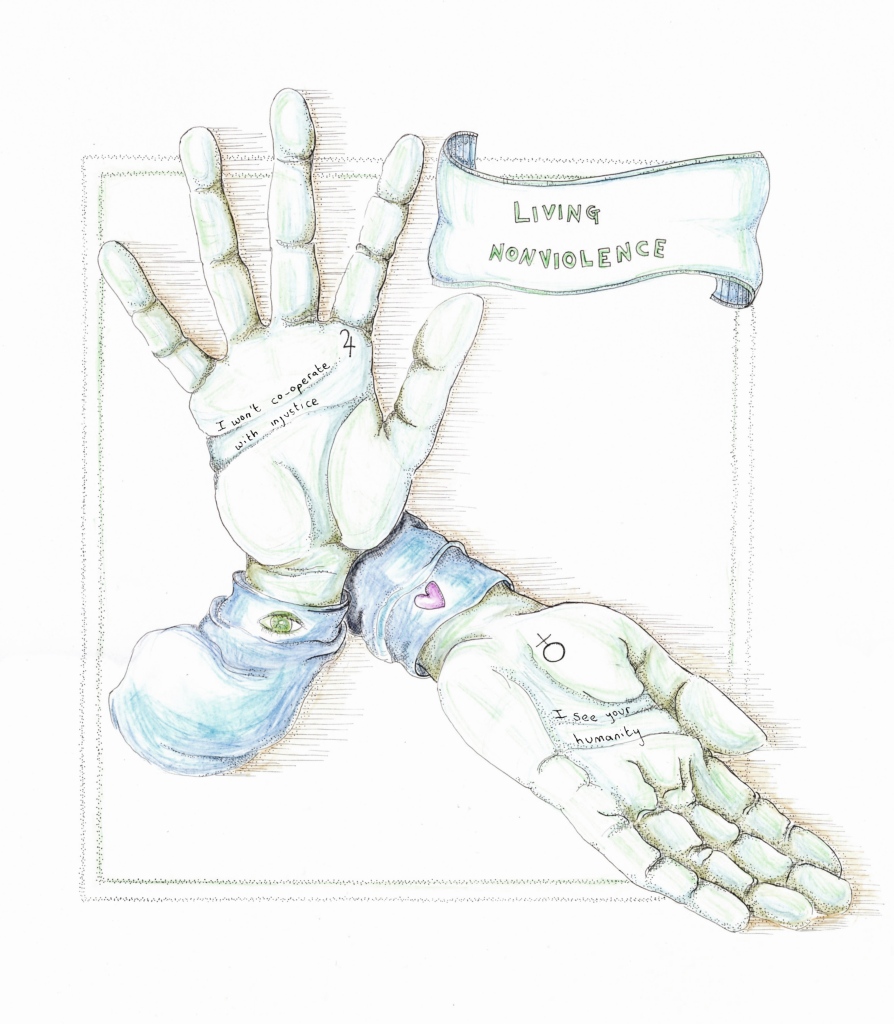
Two hands of nonviolence

This has been illustrated by my friend and collaborator with this image of two hands – it says “I won’t co-operate with injustice”, AND “I see your humanity”.

Nonviolence is not ‘not being violent’ – it is a commitment to act from a place of seeing our interconnectedness, a path, a way of being in the world. It is a path of active peace, a courageous way of being in the world, a willingness to show up in solidarity with and as an accomplice to people who are being harmed by acts of violence of any kind, while recognising the common humanity of all of us including our opponents.

While the principle might be easy to understand, the practice is challenging and something that takes effort and needs support. Along the way I have explored several frameworks and tools, and found three in particular super helpful. In this series of blog posts, I’ll explore a little the beauty of each, and maybe inspire you to find out more…

  1. Kingian Nonviolence – The legacy of Dr King lives on in six steps and practices, brilliantly supported by Kazu Haga’s work ‘Healing Resistance’.  
  2. Revolutionary Love – A beautiful rallying call for these times developed by Valarie Kaur – a compass and set of practices to support us to fight for justice with love.
  3. Nonviolent Communication – An understanding of the underlying common human needs behind all our actions, and with tangible practices to transform the habitual patterns of our minds, words and deeds.

There is so much here to explore and I am curious to see what lands. I’ll be posting on each of these topics over the coming weeks so follow this blog if you are interested!